
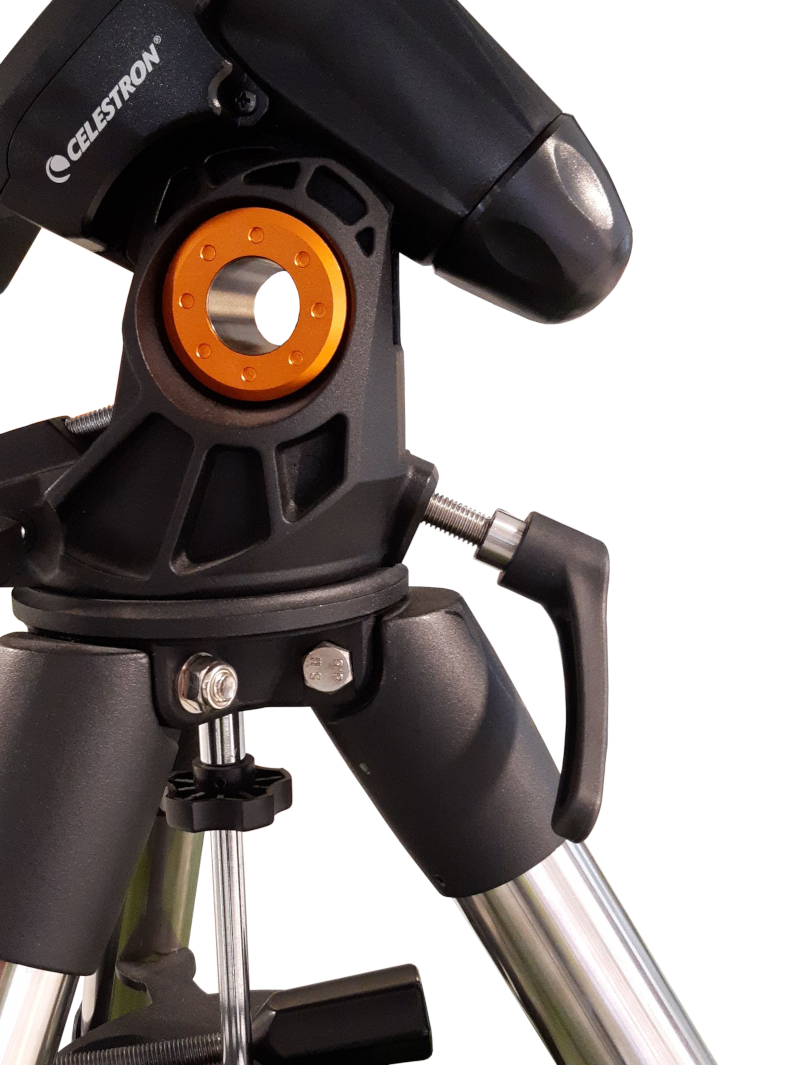
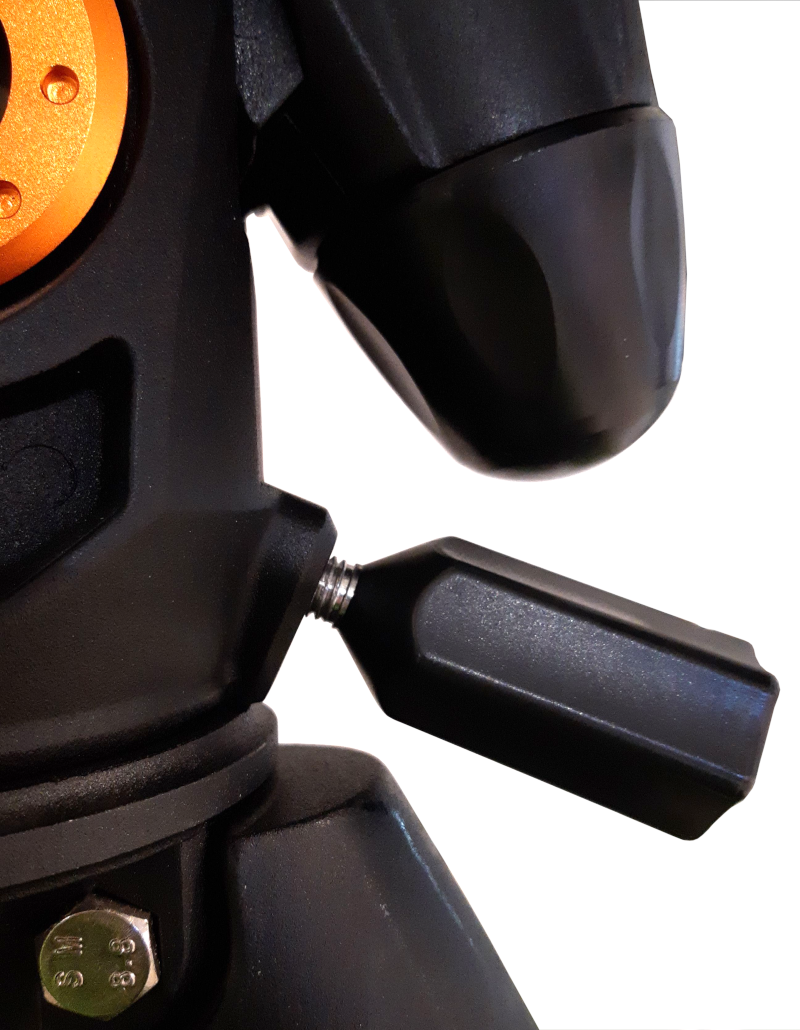
Latitude screws for equatorial mounts, stainless steel
Most equatorial mounts for telescopes come equipped with a pair of bolts for latitude adjustment. While those screws work just fine in most cases, there are situations were you might want to exchange your screws, particularly the longer of the two screws:
• The original screw might be a bit uncomfortable to use. It might have sharp corners, or be very cold to the touch, or simply feel a bit cheap.
• The grip might be too small for fine adjustment of latitude.
• Conversely, the grip might be too large. In Celestron’s Advanced VX mount in particular the screw is so long that it will block access to a polar scope at moderate to high latitudes.
• Particularly problematic: At latitudes above about 45-50 degrees, the polar alignment screw is strained in these polar alignment mechanisms. In these mounts the latitude screw pushes onto a nose within the latitude mechanism. This happens at more of an oblique angle for higher latitudes, causing a significant bending force. More than a few latitude screws have been bent out of shape because of this, sometimes entirely getting stuck in the mount, requiring expensive repair. This problem is exacerbated by the low quality steel often used in adjustment screws.
Niennas latitude screws address all of these problems.
Our latitude screws are available from Astrotec and Teleskop-Service
• The original screw might be a bit uncomfortable to use. It might have sharp corners, or be very cold to the touch, or simply feel a bit cheap.
• The grip might be too small for fine adjustment of latitude.
• Conversely, the grip might be too large. In Celestron’s Advanced VX mount in particular the screw is so long that it will block access to a polar scope at moderate to high latitudes.
• Particularly problematic: At latitudes above about 45-50 degrees, the polar alignment screw is strained in these polar alignment mechanisms. In these mounts the latitude screw pushes onto a nose within the latitude mechanism. This happens at more of an oblique angle for higher latitudes, causing a significant bending force. More than a few latitude screws have been bent out of shape because of this, sometimes entirely getting stuck in the mount, requiring expensive repair. This problem is exacerbated by the low quality steel often used in adjustment screws.
Niennas latitude screws address all of these problems.
Our latitude screws are available from Astrotec and Teleskop-Service
- Products Made in Sweden
- E-mail us, we reply swiftly!
- You find our products with astronomy retailers
- BrandNienna
- ConditionNew
- Country of originSweden
Description
The main use-case for Nienna's latitude screw is to replace a bent screw, or to avoid your screws from getting bent in the first place. At the same time you will be able to do finer adjustments thanks to the large handle. Besides, a nice stainless steel screw with a good finish is hard to beat when it comes to looks!
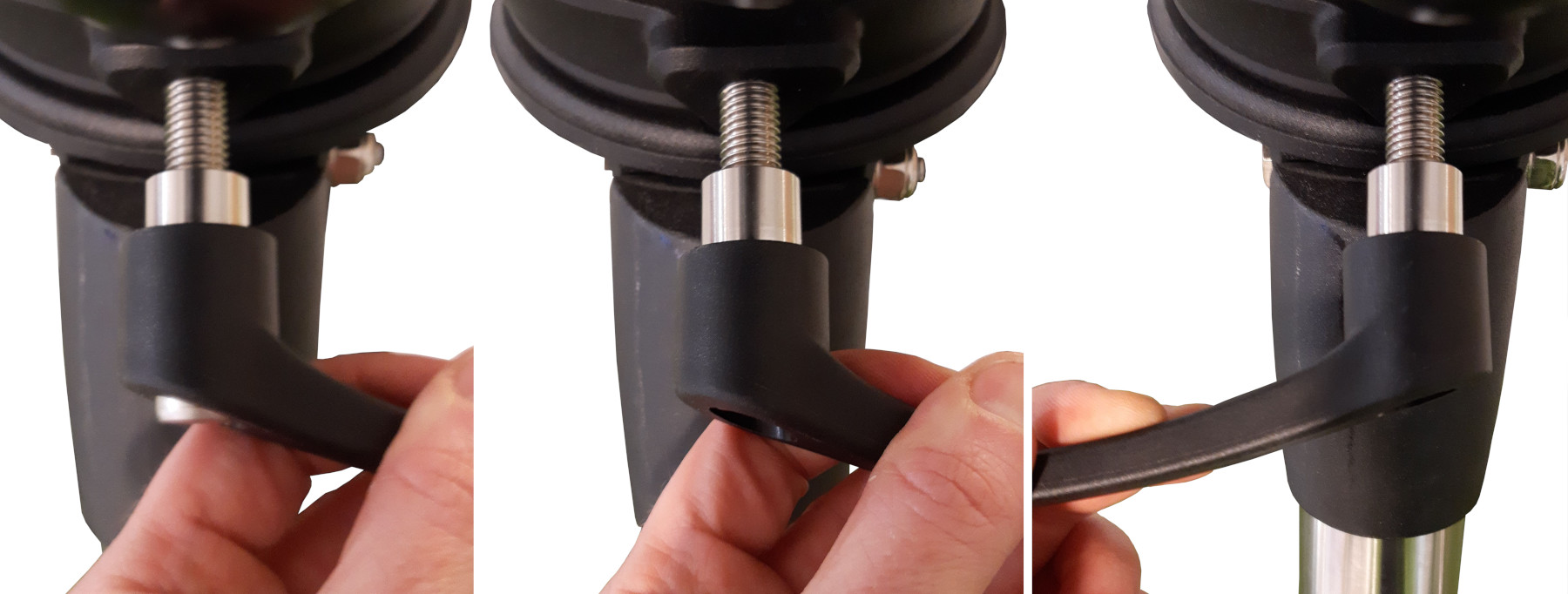
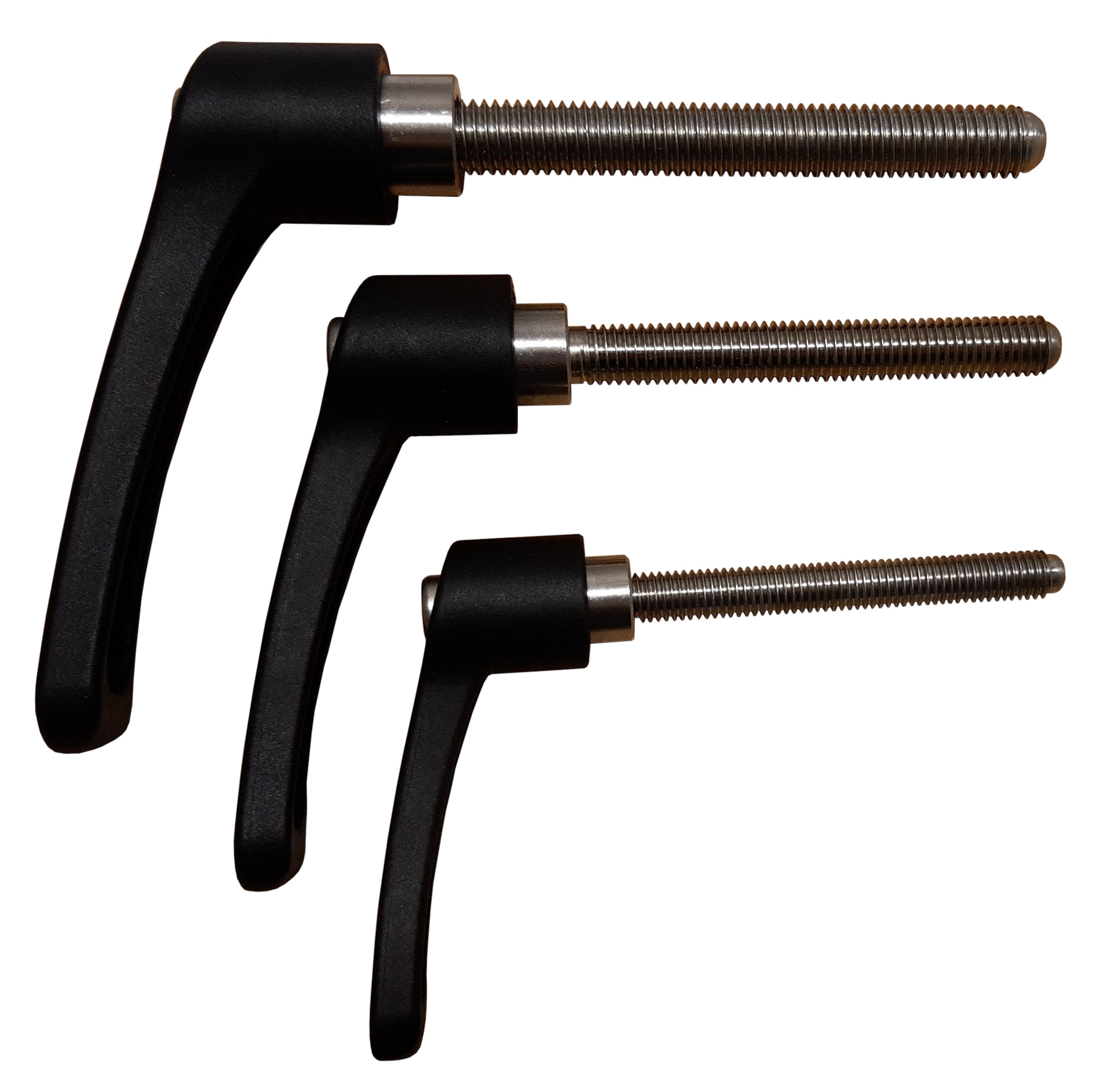
Each screw consists of the screw itself, a large handle, and a spring mechanism to engage or disengage the handle for free rotation.
The screw and the spring mechanism are made of high quality stainless steel of much higher strength than the mild steel screws commonly used in many mounts.
For the handle we chose fibre-glass reinforced plastic. The reason for this choice is improved handling comfort at low temperatures. We can make similar screws with zinc alloy handles or stainless steel handles on request, but we do not recommend this solution.
The handle is pulled into a toothed ring which locks it in place. By pulling out the handle (or by pushing the tap in the middle with your thumb) the toothed ring is disengaged and allows you to rotate the handle freely without turning the screw itself.
There are a few mounts out there which use screws in Freedom Units rather than Metric, but those are increasingly rare and Nienna does not currently offer replacement screws in these sizes.
The following is a list of known threads for the most common mounts. You will find that some mounts are listed with more than one thread. This happens when a mount has had a design change through its generations in which the thread was changed.
Please be sure to check your particular mount before ordering! For a handy trick on how to measure the diameter of your existing screws without a caliper check out our product manual!
At higher latitudes however the length becomes important in two ways:
You can try this out with your existing screw. Set your latitude on the mount, then measure how much of the threaded length of the screw is still visible. Remove the screw and measure its total threaded length, i.e. the length of the screw minus the length of its head and handle. Finally, subtract the length of the thread sticking out that you measured just a moment ago.
Once you have removed the screw from the mount you measure its threaded length to be 94mm.
If we subtract 12mm from 94mm we get an ideal length of 82mm. Let’s add a couple of millimetres just to be on the safe side and call it 84mm instead.
The ideal replacement screw in this case should therefore be as close as possible to, but not shorter than 84mm. Note: as mentioned above the screw will not usually get in the way at lower latitudes. If you have easy access to the polar scope and there is enough space between the mount and the screw to allow it to be adjusted, there is no need to select a shorter screw than the original.
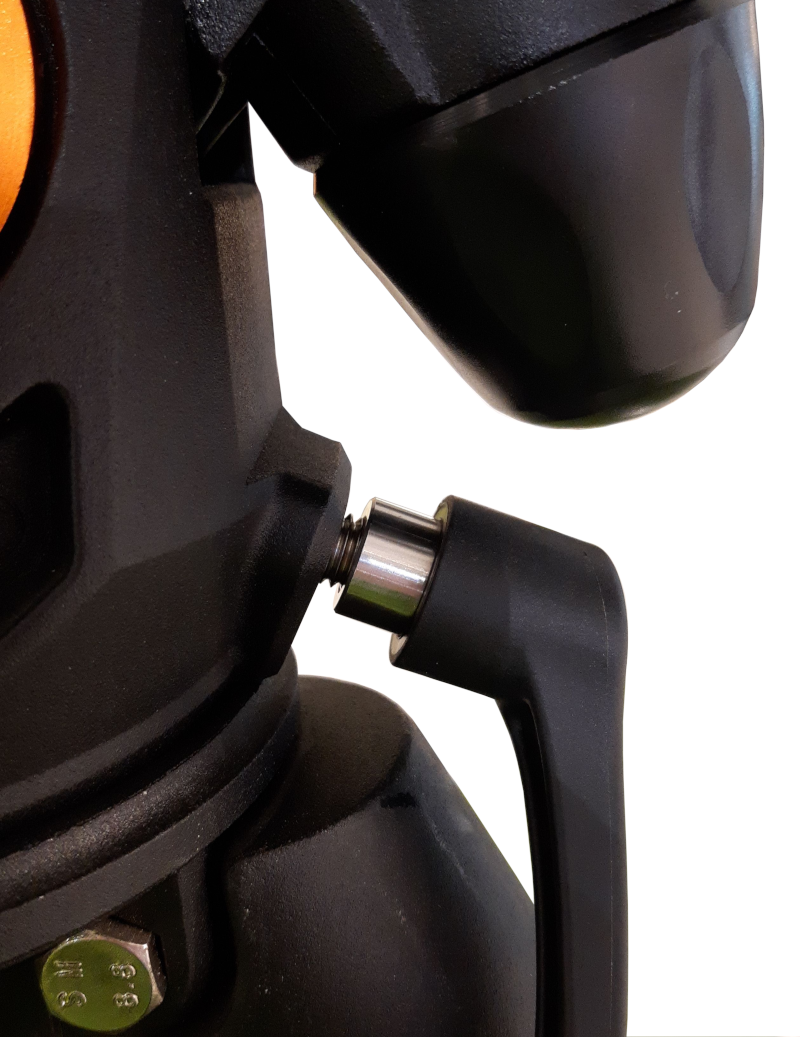
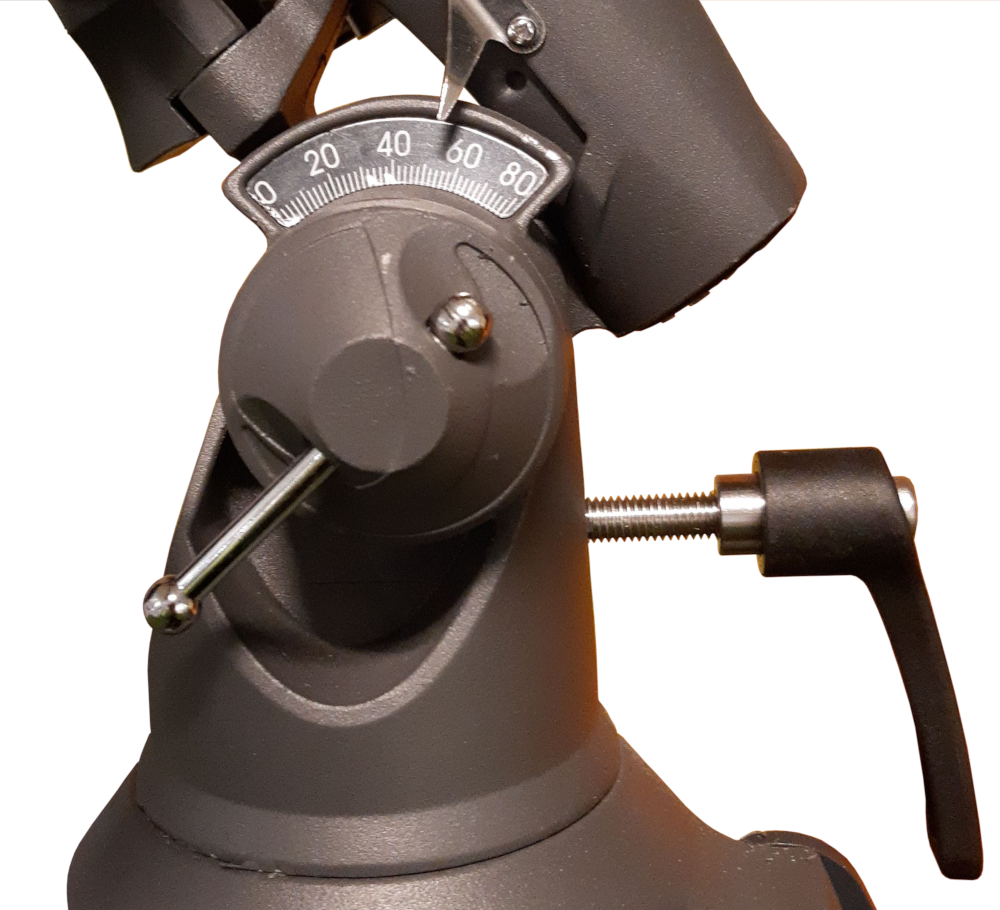
Please note that the mounts on the images are examples of use and are not included!
As mentioned earlier we have intentionally selected fibre-glass reinforced plastic for the handle. At cold temperatures handling a metal grip can be quite unpleasant. We do offer custom made latitude screws with die-cast zinc alloy or even stainless steel handles if you prefer this for aesthetic reasons, and if you deal with touching a metal grip in the cold. Zinc alloy is available at the same price as the default variant. Stainless steel handles come at roughly 75% higher cost.
Each screw consists of the screw itself, a large handle, and a spring mechanism to engage or disengage the handle for free rotation.
The screw and the spring mechanism are made of high quality stainless steel of much higher strength than the mild steel screws commonly used in many mounts.
For the handle we chose fibre-glass reinforced plastic. The reason for this choice is improved handling comfort at low temperatures. We can make similar screws with zinc alloy handles or stainless steel handles on request, but we do not recommend this solution.
The handle is pulled into a toothed ring which locks it in place. By pulling out the handle (or by pushing the tap in the middle with your thumb) the toothed ring is disengaged and allows you to rotate the handle freely without turning the screw itself.
Finding the correct thread size
Most equatorial mounts use metric threads for their latitude screws. The most common sizes are M8, M10, and M12, with the corresponding diameters of 8mm, 10mm, and 12mm respectively.There are a few mounts out there which use screws in Freedom Units rather than Metric, but those are increasingly rare and Nienna does not currently offer replacement screws in these sizes.
The following is a list of known threads for the most common mounts. You will find that some mounts are listed with more than one thread. This happens when a mount has had a design change through its generations in which the thread was changed.
Please be sure to check your particular mount before ordering! For a handy trick on how to measure the diameter of your existing screws without a caliper check out our product manual!
Sky-Watcher
| EQ1 | M8 |
| EQ2 | M8 |
| EQ3 | M8 (older mounts) or M10 (newer mounts). This is true for both the manual mount and the Synscan Pro GoTo mount. |
| EQ5 | M8 (older mounts) or M10 (newer mounts). This is true for both the manual mount and the Synscan Pro GoTo mount. |
| HEQ5 | M10 |
| EQ6 | M10 |
| EQ6-R | M10 and M12 (shorter screw is M10, longer screw is M12) |
Celestron
| Astromaster EQ | M8. This is true for both sizes of the mount. |
| Omni (CG4) | M8 |
| Advanced GT (CG5) | M8 |
| Advanced VX | M12 |
Meade
| Polaris EQ | M8. This is true for both sizes of the mount. |
| LXD75 | M8 |
Finding the best thread length
At lower latitudes the exact thread length does not matter. The worst that can happen is that the screw might stick out a bit further.At higher latitudes however the length becomes important in two ways:
- If the screw is too short then it might not reach the “nose” in the latitude mechanism.
- If it is too long it will stick out too much and either block access to the polar scope, or even block the mount from being adjusted to higher latitude angles.
You can try this out with your existing screw. Set your latitude on the mount, then measure how much of the threaded length of the screw is still visible. Remove the screw and measure its total threaded length, i.e. the length of the screw minus the length of its head and handle. Finally, subtract the length of the thread sticking out that you measured just a moment ago.
Example:
Let us say your latitude screw sticks out 12mm once you have set the mount to your correct latitude. You can directly measure this with a ruler.Once you have removed the screw from the mount you measure its threaded length to be 94mm.
If we subtract 12mm from 94mm we get an ideal length of 82mm. Let’s add a couple of millimetres just to be on the safe side and call it 84mm instead.
The ideal replacement screw in this case should therefore be as close as possible to, but not shorter than 84mm. Note: as mentioned above the screw will not usually get in the way at lower latitudes. If you have easy access to the polar scope and there is enough space between the mount and the screw to allow it to be adjusted, there is no need to select a shorter screw than the original.
Scope of delivery
Each screw comes pre-assembled. A kit consists of exactly one screw. This is because typically only the longer of the two screws on most mounts might need replacement.Please note that the mounts on the images are examples of use and are not included!
Notes
We have selected this particular shape and size of the handle to achieve a good compromise between smooth function, robustness, and sufficiently compact size. We are aware that there are instances where a smaller handle might be advisable - for example on the EQ3 mount at very high latitudes. Thus there are cases where we would advise against the use of our screws for this reason.As mentioned earlier we have intentionally selected fibre-glass reinforced plastic for the handle. At cold temperatures handling a metal grip can be quite unpleasant. We do offer custom made latitude screws with die-cast zinc alloy or even stainless steel handles if you prefer this for aesthetic reasons, and if you deal with touching a metal grip in the cold. Zinc alloy is available at the same price as the default variant. Stainless steel handles come at roughly 75% higher cost.
Files and media
 | Manual (Swedish) |
| Manual (English) |
| Manual (German) |