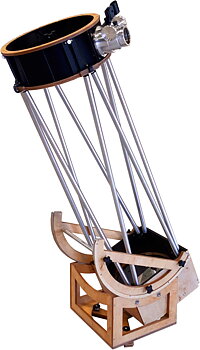
Dobsonian telescopes
For the past two decades a massive revolution has taken place, putting astrophotography at the top of most amateur astronomers' minds. Most telescopes and accessories are designed to work best for photography, or at the very least to make photography an option. At no earlier point in history has it been possible for amateurs to capture images of the night sky that could rival or beat what professional astronomers did just a few decades ago. This development, whilst obviously great, also has a dark side. Astro imaging craves attention. You can't just go out and take a few images if you want to measure yourself against others (as many tend to do). Instead, it takes a great deal of effort to photograph objects on the night sky. It is this very effort and required attention that distracts us from just "being" under the night sky and experiencing the deep fascination we feel when contemplating the vastness of space. Whilst photographing, at that very moment we are expert operators of advanced gear - not amateur astronomers in the purest sense of the word.
Far be it for me to imply that this is in any way a "lesser" activity, quite the contrary! However I would say that the pure enjoyment of the night sky should not be wholly discarded.
Wherever you sit on the spectrum, whether you forego photography entirely, or try to include visual observations once your photo gear is up and running, or whether you opt to focus on either photography or observing on any given night - in all of these situations a simple, easy to use, quick to set up telescope that provides great views of the sky comes in handy. One where close to no thought needs to go towards operating the telescope, where all of your attention can be on the moment and the experience itself.
Unfortunately a telescope that will work for astro imaging needs to meet a number of requirements which are not relevant for "simple" visual use. As a bare minimum you need a sturdy (and thus heavy) mount which allows you to track the objects across the sky with near perfect precision. The mount will probably need to be computerized, allowing it to communicate with a laptop that will handle the necessary autoguiding process. And of course, since mechanical stability of the system is absolutely crucial, you will need to intentionally downsize the telescope in relation the the size of the mount. Add further complications like a high capacity power supply and you end up with gear that costs more, requires deep knowledge from the operator (that's you), takes a great deal of time and effort to set up properly, and in the end doesn't perform nearly as well as a cheaper telescope that's optimized for visual use in the first place.
This is where the classic Dobsonian telescope comes in
Dobsonians are essentially perfectly ordinary Newtonian reflectors, only instead of a sturdy and complex mount a much simplified mechanical solution is chosen and electronic components are left on the wayside. All of the money is focused on buying the largest possible mirrors. At the same time anything that isn't absolutely necessary is left out in order to reduce the cost. The classical Dobsonian offers the largest possible aperture within a given budget - and it is the aperture more than any other aspect of a telescope that will determine how much you can see. John Dobson, inventor of the eponymous telescope, ruthlessly optimized his telescope for visual observing at the expense of everything else. Even today you can still find Dobsonian telescopes, especially in the lower price range, that largely follow his example. For instance you will be able to get a quite large telescope of 300 mm of aperture at around 1000 Euros. No matter how exceptional any telescope may be, no telescope of less than 300 mm will be able to wholly match the larger telescope. Yes, the telescope has other downsides especially when it comes to moving such a bulky instrument, but in terms of its all important light gathering power a large instrument can't be beat.
"Dobsonian telescopes offer the best bang for your buck for visual astronomy."
Unless you have specific requirements that preclude it, a Dobsonian at a low price point is so well suited for visual observations that it will handily beat smaller telescopes regardless of their cost or complexity.
How does the Dobsonian telescope do that?
If you break it down to the basics, any telescope consists of several parts:
- The optics themselves in the form of either mirrors, lenses, or a combination of the two. For visual use you need to add one or more eyepieces which will determine your magnification.
- The tube whose only real job is to hold the optical components at the right distance to each other as well as in the right orientation.
- A mechanical device that holds the telescope and allows you to move it to view any point on the sky. This device is referred to as a mount.
The Dobsonian telescope in its purest form radically optimizes 1) and 3). If something isn't needed for visual observations it is left out.
The optical design is that of a Newtonian reflector. This design is particularly cheap to make when compared to all other telescope designs, especially once you reach larger apertures.
But the all-important difference that makes a Dobsonian a Dobsonian is its mount. For astro photography no expense is spared to achieve near perfect tracking of the object, a strict requirement for long exposure times. Next, the mechanical stability needs to be excellent. Finally, the mount needs to be able to talk to a computer in order to understand correction commands to eliminate the remaining tracking error. All of this costs money. All of this multiplies complexity. Yet none of it, except to a degree the wish for good mechanical stability, is at all required for visual astronomy!
In a Dobsonian the mount is nothing more than a simple (often wooden) box that can be pivoted to the side. This so-called rockerbox doesn't utilize nifty mechanical gears or motors. All there is are some teflon pads gliding over a surface. Friction does the job. The same is true for moving the telescope in the up-down axis. Two wheels, one on either side of the telescope's tube, are placed on top of some more teflon pads. The telescope is balanced so it won't move on its own accord. But at the user's touch it starts to move with just the right amount of friction to provide fine control. No locking screws. No fine adjustment controls. No motors. Just you, a wooden box and friction as your friend. You won't even need a tripod, just place the rocker box straight on the ground.
This simplicity is what keeps the cost down whilst still providing good mechanical stability. You only need to work around the fact that no GoTo system ("autopilot for your telescope") locates objects for you.
"Dobsonian telescopes combine the cheap and cheerful Newtonian telescope design with barebones mechanical solutions. This makes the telescope such a bargain."
In their purest form, Dobsonian telescopes are do only one thing, but do it well: excellent light gathering power and image quality at the lowest possible price. The telescope doesn't suffer from the absence of any finesse - it thrives exactly because of it!
One Dobsonian telescope for everyone?
Purebred Dobsonians are a perfect system. But that doesn't mean they are perfect for everybody. The user needs a certain mindset where learning to locate objects on the night-sky isn't a scary proposition but rather a great part of the fun. You need some patience, and you need to build the muscle memory to operate the telescope with ease. All of this can be achieved by almost anyone. But one critical decision cannot be avoided: if you opt for a Dobsonian telescope, you will pretty much have to stick to visual astronomy. Yes, today it is possible for determined astrophotographers to get astonishing results even with Dobsonians. But the fact remains that if the goal is to take pictures, the Dobsonian isn't for you.
"Dobsonians are ruthlessly optimized for pure visual use."
We have learned that you need to make a number of sacrifices with a Dobsonian telescope. In return you get something that no more advanced telescope can give you: a much more immediate, raw experience of the night sky. Technology takes a back seat and lets you get on with your observations. What you see is the real light that came to you straight from the object, having travelled for thousands or millions of years before reaching your retina. This is remarkably different from the kind of image you view on a computer screen. There you see the end result of a long process, removed from the immediate experience by several layers of abstraction. Not fake, but less "present" for lack of a better word. With a Dobsonian you put in the hard work: you carefully selected the object, found it with the help of star charts, spent many minutes viewing it after having learned proper observing technique (yes, there is such a thing!), followed the object by carefully moving the telescope, by hand! A Dobsonian is like a venerable old "acoustic" bicycle, with no motors and the bare minimum of mechanical parts needed to give the user superpowers.
So, is a Dobsonian the right telescope for you?
Having read this you will have had a gut reaction somewhere between two extremes: you either find the whole concept of a Dobsonian utterly attractive, or you don't get why you should be asked to make life harder than it needs to be, and what's wrong with advanced technology anyway? More likely you lie somewhere in between. Neither extreme is wrong, neither is right. You are a "serious" amateur astronomer whether or not you use high-tech, and whether or not you can find your way across the night sky without aid. This isn't what it's all about.
"Quite simply, we are all different. What is the perfect telescope for one may be so much scrap-optics for someone else."
Entirely without a value judgement we need to appreciate how much of a trend astrophotography is. And for very good reasons: You can share images with your friends; maybe you feel the urge to compete with some of the best astrophotographers out there. All of this is normal, and happily well catered for by the telescope market. No matter how much technology you want in your telescope, you will find something that fits you very well. Maybe at a high price point, but there is something to suit all needs. The classic Dobsonian telescope seems to be from a different time. But it offers something no other telescope can: an immediate and direct connection with space in all its glory. Maybe this is wishful thinking, but we believe that there is a growing desire to occasionally just put aside all of the technology that surrounds us all day, set aside your competitive streak, and simply enjoy your time out under the night sky. Very likely this is not for everyone, but we truly believe that many a reader will identify with this on some level.
Care for a little comfort?
Most of us probably don't sit at either extreme. We can appreciate simplicity, but we don't mind using modern comforts where they fit. For this reason the classic Dobsonian telescope has diverged to fit different needs. A relative simplicity of design is still the standard, but outside of this there are many properties you can optimize a Dobsonian for:
- low weight, especially in regards to the weight of the single heaviest component you need to carry
- compact dimensions for transportation
- robustness for transportation
- smooth movement for easier tracking
- Goto (computer control) that will locate objects for you
- better quality mirrors for better image quality
- even larger mirror for greater light gathering power
- well designed mirror cell for better image quality
- simple alignment (collimation) of the mirrors, ideally without tools
- quick and simple assembly
- assembly and use with only one hand
- observations with a dominant right or left eye
- local manufacture
- aesthetic considerations
- repairability
Some of this can be achieved at the same time at the cost of, well, cost. Other properties conflict with each other, for instance a larger mirror on the one hand versus compact dimensions for transportation on the other. The art of designing a Dobsonian lies in weighing these and other factors and finding a good compromise between them to suit your target audience. Which properties are must haves? Which are nice to have? Which ones can be sacrificed?
Different telescope makers find a different balance. You as the user can select the telescope that best matches your own use-case.
Where do Nienna's Dobsonian telescope sit in all of this?
When designing our Dobsonians we did a lot of soul searching and tuned the design to optimally suit certain users. At the same time we encourage the customer to discuss their specific wishes with us. We can make most things happen.
Our base models are manufactured in very small scale production runs. They are primarily optimized for low weight and compact dimensions, but not at the cost of ergonomic and quick setup and operation.
We also make telescopes designed from the ground up to suit a customer's specific needs.
Most commonly we have a discussion with our customer where we start with a base design and then modify it to match the individual requirements our customer might have.